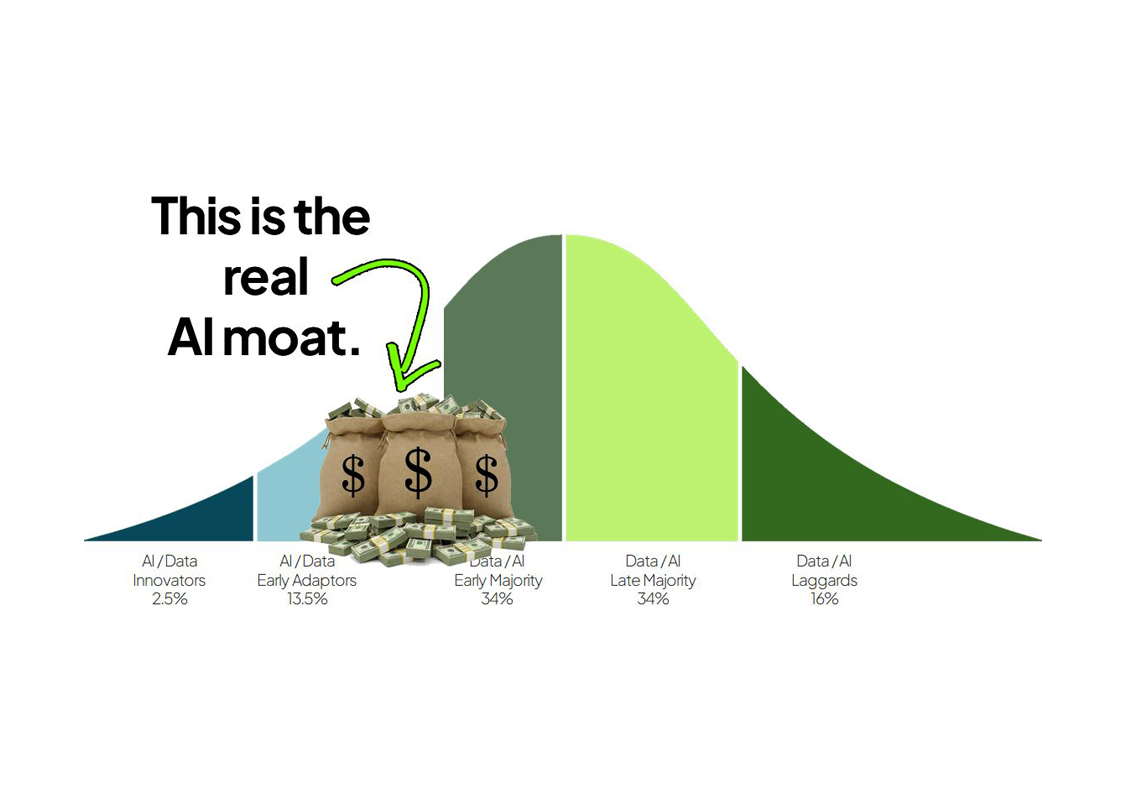
I recently heard a CNBC commentator claim there’s no AI moat - because the same technology, money, and talent are available to all major players. But that’s exactly the problem.
Access to those resources is the moat…for everyone else.
In AI, the real advantage is:
▪️Top Talent: armies of data scientists and engineers.
▪️Unlimited Compute: tens of thousands of GPUs on demand.
▪️Massive Infrastructure: built for scale, real-time speed, and experimentation.
▪️Execution Flywheels: where each success funds the next.
All of that boils down to money. JPMorgan can afford to hire (and retain) 1,200 data scientists and engineers - can your organization? Meta can afford to spend tens of billions on AI infrastructure - does your organization have access to these data centers? Also, incidentally, have you seen your cloud bill recently?
Large enterprises can afford to spend millions for top consultancies to provide AI strategy playbooks and execution plans - does your organization have a plan (that wasn’t generated by an intern with ChatGPT)?
The moat isn’t disappearing. It’s widening.
That’s frustrating to see because, in most technology cycles, the moat narrows over time. Costs drop. Access broadens. Adoption spreads. But with AI, the leaders are accelerating away from the pack. The moat has become a chasm, and the early adopters are just pulling away.
That’s why we started Savvi AI - we saw firsthand that everyone needed a bridge to get to the other side. A way to start now with the (limited) resources they already have. A way to apply AI to real business problems in environments that aren’t perfect, with budgets that aren’t infinite.
This reminds me of the quote, “The future is here, just not evenly distributed.” In AI, that uneven distribution and uneven access to resources is the moat. But it doesn’t have to stay that way.