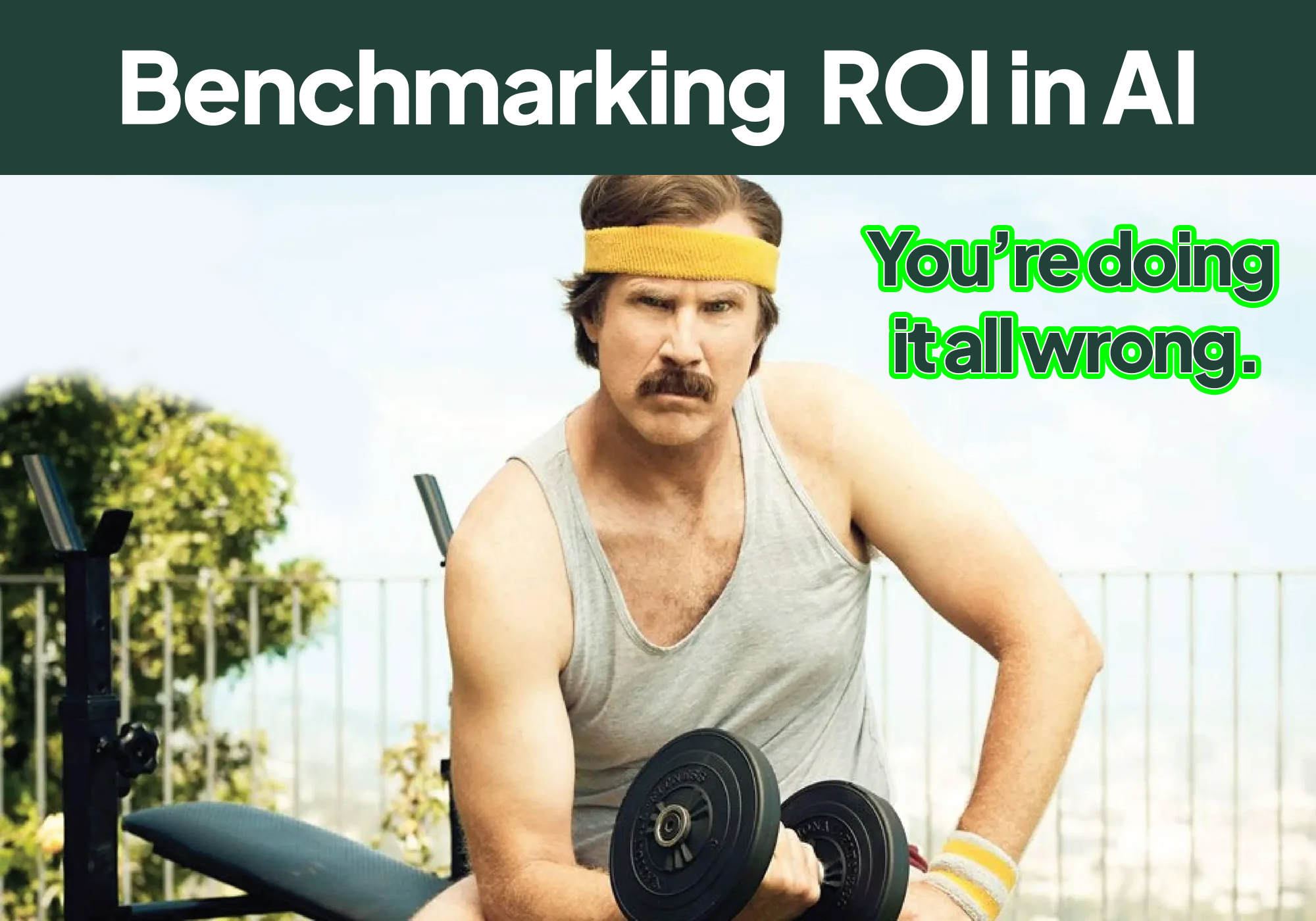
Many enterprises are measuring ROI in AI all wrong.
Executive teams are all wrestling with "How do we calculate the ROI of AI?” Often with a skeptical and weary CFO who’s being constantly pressured to spend more from all sides. But it’s the mistaken logic that comes next that show me why these particular enterprises are struggling with adoption.
Mistake #1: THE “TIME SUNK COST” TRAP"
If we save each person on our team 3 hours a week but their salary stays the same, we haven't actually saved any money."
This logic only holds up if your business isn’t growing. If you are growing, then you know that saved time and the elimination of low-value work means more capacity. And more capacity means you can scale revenue without scaling costs. If you think saved time has no value, you’re essentially admitting that your company has no upside to increased capacity - and that speaks for itself.
Mistake #2: THE "ONE-REP-AND-RIPPED" GYM LOGIC
I see companies treat a 3-month AI pilot like it needs to pay for itself immediately. It’s like going to the gym, lifting a 50lb weight once, and quitting because you aren’t buff yet. AI requires reps. Results compound. The point of a POC isn’t immediate profit - it’s proving the work can be done and building confidence so you can start scaling it.
Also, beware of "instant results" as this corporate equivalent of herbal muscle-builder pills. View it with the same skepticism.
Mistake #3: THE "SPECIAL SNOWFLAKE" SYNDROME
Think about your data warehouse or your CRM. Did those pay off in weeks? Of course not. They were major infrastructure investments, and enterprises gave them years to mature. But they paid off in better decisions, visibility, and growth. AI is no different.
Ironically, faster innovation depreciation schedules and lower build costs make the math even easier today than a decade ago. But only if you are evaluating AI as core infrastructure, not isolated experiments.If you hunt for ROI on a narrow project-by-project basis, you’re likely to quit before building any organizational AI muscle. You’ll lose focus, lack strategy, and miss the long-term leverage of AI because you were busy over analyzing a three-hour time save.
AI ROI should be measured as a mix of capital investment, R&D, and operating leverage, not just as a one-and-done cost savings exercise.